
Trends & Insights
·
March 5, 2026
GUIDE: What To Look For In An Adblock Recovery Provider
GUIDE: What To Look For In An Adblock Recovery Provider
Trends & Insights
·
March 5, 2026


compliant

Introduction
This guide is written for publishers whose business model is primarily or significantly supported by advertising revenue — where ad yield isn't a nice-to-have, it's the thing that keeps the lights on.
For these publishers, the preferred approach to adblocking traffic is to recover advertising. Other models — subscriptions and micropayments — are either considered unproven or too marginal to move the needle. Therefore, ad recovery is what this guide focuses on.
How To Think About Ad Recovery
When you read about adblock recovery on vendor websites, in the press, and on social media, it can all sound pretty confusing. Various facts and figures. Ill-defined metrics like "recovery rate" paired with terminology like "whitelisting" and "walls" that do not seem apples-to-apples.
When you cut through the hyperbole, there are two core elements that matter. They are:
- 🚫 Blocked pageviews. How many measured pageviews were blocked from serving ads in a monthly, quarterly, or yearly period. What percentage of total pageviews this represents.
- ⚙️ Ad recovery method. How ads are being recovered. The capabilities and limitations of that method.
Schools Of Thought
There are four main schools of thought when it comes to ad recovery for adblocked traffic.
These inform how adblocking is measured and the method used for recovery. They are central to how you should evaluate any solution.
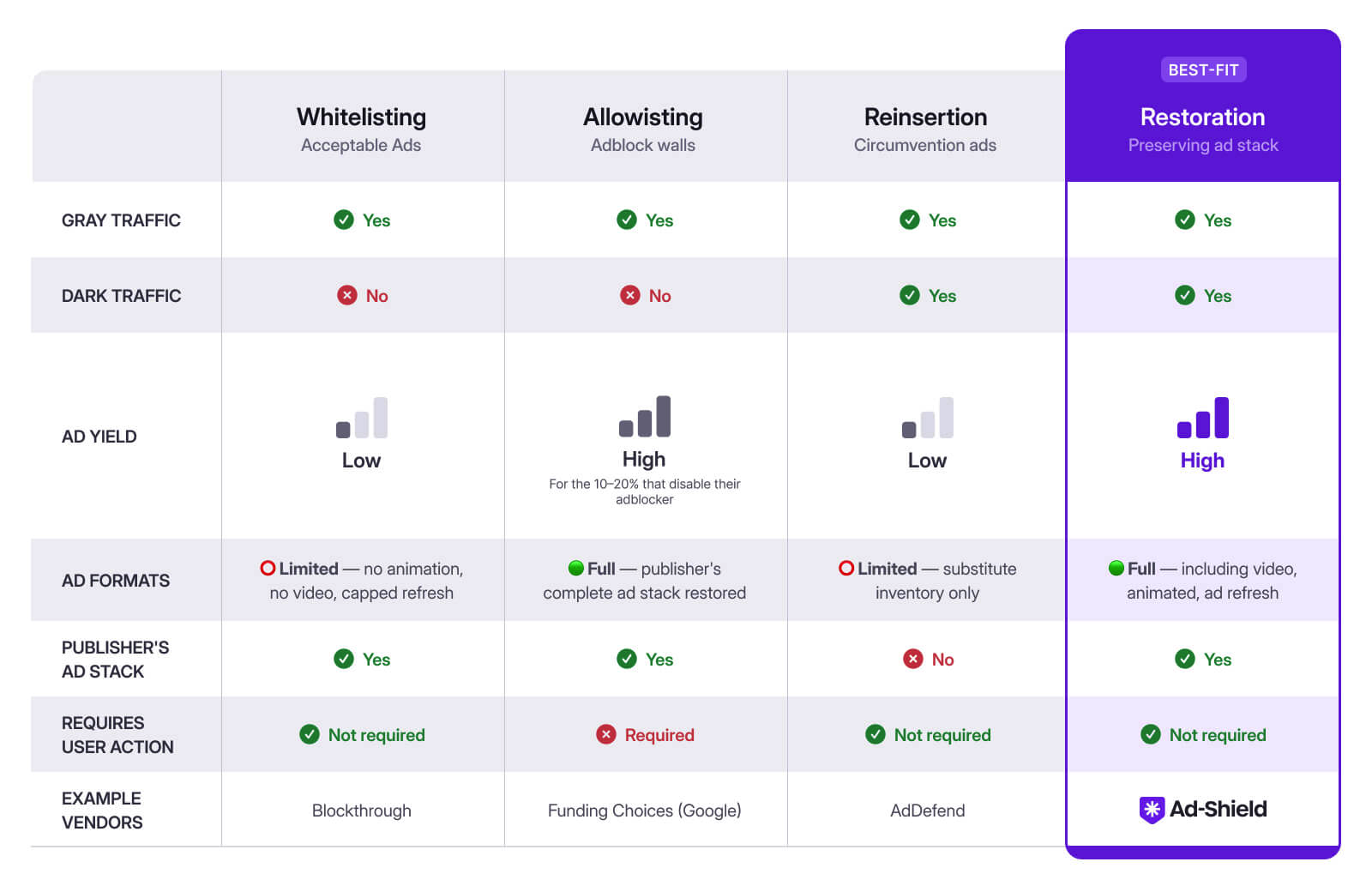
- 🏳️ Whitelisting. This method relies on paying adblockers in exchange for allowing ads through. Acceptable Ads is the primary mechanism through which this occurs. Solutions such as Blockthrough depend upon it in order to recover ads.
- 🚧 Allowlisting. This method relies on an appeal to the user, by displaying a message requesting the adblocker is turned off for that individual website. This can be done via a “hard wall” approach (withholding content access until the website is allowlisted) or a “soft wall” approach (maintaining access to content, regardless of the user’s choice).
- 🔁 Reinsertion. This method bypasses the adblocker and reinserts alternative advertising directly into the webpage. The publisher's original ad stack is not reinstated — the ads served are substitutes, rather than originating from existing demand relationships.
- 📈 Restoration. This method restores the publisher's full ad stack, preserving the infrastructure that enables the page to load the publisher's own ads as originally intended. The publisher's existing demand relationships — GAM, Prebid, SSPs, direct-sold — are reinstated in full.
The Adblocking Landscape In 2026
Not all adblocking traffic is the same. Understanding the difference between the two main types is the most important thing a publisher can do before evaluating any recovery solution.
Gray traffic
21% of adblocking traffic
Gray traffic is the adblocking audience type the industry is most familiar with. It is generated by soft adblockers — browser extensions like AdBlock and Adblock Plus, owned by a company called eyeo.
These tools block ads, but they allow analytics scripts to run, “turn off your adblocker” walls to display, and cookie banners to load. They also participate in a program called Acceptable Ads, which allows publishers to serve ads that meet a certain criteria, in exchange for making a payment to eyeo. Gray traffic is captured by analytics tools like Google Analytics, and, standard adblock analytics.
✅ Analytics (Google Analytics)
✅ Acceptable Ads (Blockthrough)
✅ ”Turn off your adblocker” walls
Dark traffic
79% of adblocking traffic
Dark traffic is generated by a newer generation of tools called brutal adblockers — products like uBlock Origin, AdGuard, Brave, NordVPN, and hundreds more.
These block everything: ads, analytics scripts, “turn off your adblocker” walls, cookie banners, paywalls, and affiliate links. They do not participate in Acceptable Ads. A visit from a brutal adblocker user often leaves no trace in a publisher's dashboard and cannot be detected or measured by standard analytics tools.
❌ Analytics (Google Analytics)
❌ Acceptable Ads (Blockthrough)
❌ ”Turn off your adblocker” walls

The shift the industry missed
For most of the industry, adblocking still means gray traffic. That understanding is outdated. Today, dark traffic represents 79% of all adblocked traffic. Gray traffic accounts for just 21%.
Brutal adblockers have quietly overtaken soft adblockers to become the dominant force in the ecosystem — and because dark traffic suppresses the very tools publishers use to measure it, the shift went largely unnoticed.
What This Means For Each School Of Thought
Now the distinction between gray and dark traffic has been established, it becomes possible to evaluate each recovery method on the most important dimension: which audience can it recover revenue from? Followed by: how effectively can it recover that revenue?
Whitelisting (Acceptable Ads)
Whitelisting depends entirely on the adblocker participating in the Acceptable Ads program. Soft adblockers do. Brutal adblockers do not. This means whitelisting-based solutions can only reach gray traffic — the 21% of adblocked traffic that is already visible in a publisher's dashboard. The 79% that constitutes dark traffic is out of reach for revenue recovery.
Beyond coverage, Acceptable Ads imposes strict restrictions on the formats that can be served. These tend to be the formats advertisers bid least aggressively for — limited sizes, no animation, no video. The outcome is it generates relatively low yield compared to what the same inventory would command through a fully restored ad stack.
☑️ Gray traffic
⬜ Dark traffic
▂ Low ad yield
Example vendor using this method: Blockthrough
Allowlisting
Allowlisting depends on the two things:
1 . The user seeing a “turn off your adblocker” message
2. The user being able to act on it
For gray traffic visitors, this is possible — the message displays, and the user can choose to allowlist the site. For dark traffic visitors, it is not. 51% never see the message at all — brutal adblockers suppress it entirely. Additionally, 57% cannot disable their adblocker even if they wanted to — because it was installed at an IT-level. The combined effect is that 80-90% of dark traffic visitors do not disable their adblocker.
When allowlisting does work, the yield is high. Because the visitor has disabled their adblocker entirely, the page loads as it would for any non-adblocked visitor. The publisher's full ad stack, full demand relationships, and full format range are all restored. The significant caveat is that only 10-20% of adblocked visitors will actually disable their adblocker, meaning the revenue recovered is a high yield from a small converted audience.
☑️ Gray traffic
⬜ Dark traffic
▇ High ad yield*
*For the 10-20% that disable their adblocker
Example vendor using this method: Funding Choices (Google)
Reinsertion
Reinsertion bypasses the adblocker, which means it can reach both gray and dark traffic visitors in a way that whitelisting and allowlisting cannot. However, because it serves substitute demand rather than restoring the publisher's own ad stack, the RPMs generated are determined by the depth and strength of that substitute demand — which is usually weak. Coverage is broad, but yield is low.
The reason yield suffers is straightforward: reinsertion relies on a limited pool of advertisers bidding specifically for adblock recovery inventory, rather than the full breadth of programmatic demand competing for the publisher's own inventory. Addressability is the strength of this method. Yield is the trade-off.
☑️ Gray traffic
☑️ Dark traffic
▂ Low ad yield
Example vendor using this method: AdDefend
Restoration
Restoration preserves the existing ad infrastructure on the webpage, making both gray and dark traffic reachable. And because it reinstates the publisher's full ad stack — GAM, Prebid, SSPs, direct-sold — the ads served are the publisher's own inventory, at the RPMs their demand relationships command. Of the four methods, restoration is the only one that combines broad coverage with full yield potential.
The reason yield is high is the same reason it is high for non-adblocked inventory: the full depth of programmatic demand — including premium formats like video — is competing for every impression. The publisher's existing advertiser relationships, floor prices, and deal structures are all preserved. Restoration is the optimum balance of reach and yield, recovering the largest audience at the strongest possible RPM.
☑️ Gray traffic
☑️ Dark traffic
▇ High ad yield
Example vendor using this method: Ad-Shield
How To Evaluate A Provider
Before assessing any specific provider, first establish which school of thought they are operating from. This single question determines the ceiling on what they can deliver — both in terms of which audience they can reach (gray or dark traffic) and what level of yield they can recover from it.
Which school of thought is the best fit for you?
A publisher's objective is to maximize revenue whilst keeping its audience happy. When evaluated against that objective, restoration is the strongest fit for the vast majority of ad-supported publishers.
It addresses the full adblocked audience — gray and dark traffic combined — and does so at full yield, using the publisher's own demand relationships. For any publisher with an established ad stack, whether its in-house or provided via a partner like Freestar or Publift, it is the most commercially effective option available.
That said, there are edge cases where a different method may be a better fit:
Allowlisting
Best fit for: A publisher that can consistently convert 80%+ of their adblocked visitors into non-adblocked ones. Achieving materially above the 10-20% range is uncommon (we have yet to meet such a publisher!), making this purely theoretical.
On the few occasions we have heard of publishers with high allowlisting conversion rates, it turned out they were not measuring the full scope of adblocking traffic on their website. Meaning, the conversion rate figure was significantly overstated.
Reinsertion
Best fit for: A publisher that does not have their own ad stack to restore — for example, a newer publisher that hasn’t built out their demand relationships, or one relying on a lower-yield solution like Google AdSense. The demand provided by a reinsertion solution may produce a higher yield.
What to ask for providers utilizing each approach
Whitelisting
- What will the fill rate be?
👉 In this calculation, ask them to exclude supply donated to charitable causes. - Do they recover direct sold inventory? What is the fee for this?
👉 If so, make a counter offer with a lower rate.
Allowlisting
- Do they take a revenue share from users that disable their adblocker in perpetuity?
👉 If so, make a counter offer with a time period cap. - Do they measure churn or bounce behaviour post-message?
👉 If not, it is difficult to determine what is causing adblocking rates to drop: loyal visitors not returning, or visitors turning off their adblocker. - Do they measure what percentage of users who allowlist, go back to blocking ads?
👉 If so, ask for the re-block rate and how it trends over time.
Reinsertion
- Where does their demand come from? Are they transparent about it?
👉 If not, the quality of advertising could be poor. - Is integration straight-forward?
👉 If its convoluted, it can add unnecessary security risks. - Do they reinsert ads inline with a user-friendly standard, like Better Ads?
👉 If not, the ad experience could cause friction with your audience.
Restoration
- Are they compatible with dark traffic?
👉 If not, they are missing 79% of adblocking traffic. - Are they able to restore the full ad stack, not just part of it?
👉 If not, ad CPMs will be much lower. - Do they have a proven-track record for 2+ years, with credible customers?
👉 If not, it suggests their technology is not sustainable.
🟥 Red Flags To Watch Out For
👎 Rule of thumb: If an adblock recovery provider claims to have a recovery rate of “90%+”, they are not including dark traffic in that calculation.
1. They report recovery rate as a percentage of adblocked traffic, not total traffic.
Recovery rate expressed as a percentage of adblocked traffic sounds compelling but is fundamentally misleading. The reason is simple: a provider can only measure what their technology can detect.
Solutions that cannot identify dark traffic will report a recovery rate that misses it — making their coverage appear far stronger than it actually is. A provider reporting 90% recovery of adblocked traffic may, in reality, be reaching as little as 20% of your true adblocked audience once dark traffic is accounted for.
The only meaningful “recovery rate” benchmark is when recovery is expressed as a percentage of total traffic. This is a more apples-to-apples metric to use for comparison purposes. Any provider resistant to framing their performance this way is worth treating with caution.
How to tell the difference?
A recovery rate that is high double-digits (90%+) is measuring against total adblock pageviews. A recovery rate that is low double-digits (10-20%) is measuring against total adblock pageviews.

2. They cannot explain how their technology holds up over time — or which adblockers they choose not to recover from, and why.
The adblocking landscape is no longer a handful of browser extensions. It is a highly fragmented ecosystem spanning DNS-level blockers, VPNs, apps, browsers, security software, and network-level infrastructure — each operating differently, and each requiring a different approach to recovery.
A sophisticated provider will not claim to recover from every adblocker indiscriminately. They will have a considered view on which audiences are worth recovering from, why, how, and what that means for average recovery rates. The most effective recovery strategies are selective by design.
The question to ask is not simply "what is your recovery rate?" — it is "which adblockers do you recover from, which do you not, and what is the reasoning behind those choices?" A provider that can answer this with specificity and a clear rationale is operating with genuine sophistication. One that simply quotes a headline recovery percentage without this context is not.
How To Make A Final Choice
The choice of provider begins with the choice of method — and for the majority of ad-supported publishers, that means restoration.
Dark traffic now represents 79% of all adblocked traffic, and restoration is the only method that addresses it at near-full yield using the publisher's own demand relationships.
When evaluating restoration providers specifically, three things matter: compatibility with dark traffic, ability to restore the full ad stack rather than a partial version, and a proven track record of at least two years with credible publishers. Longevity is the most reliable signal that the technology is sustainable.
At the time of writing, Ad-Shield is the only provider that meets all three criteria — purpose-built for dark traffic, restoring the full publisher ad stack, and with a demonstrated track record of doing so at scale.
Publishers who ask the right questions will find the field narrows quickly. The revenue is there. The audience is there. The only variable is whether the provider you choose is built to reach it.

Ad-Shield enables open web publishers to measure and monetize the 79% of adblocking traffic that is not captured by their existing adblock recovery stack.
Most publishers see a 4-5X adblock revenue increase.

.png)

