
Trends & Insights
·
February 4, 2026
IT-Level Adblocking Has Reset The Recovery Playbook
57% of users never chose to block ads and are unaware they are doing so.
IT-Level Adblocking Has Reset The Recovery Playbook
Trends & Insights
·
February 4, 2026

compliant

For a decade, publishers treated adblocking as a user choice problem. Put up an adblock wall. Provide an Acceptable Ads-based experience. Ask nicely. Give users options they opt into.
That playbook has become a relic.
Not because users changed their minds. But, because now, the majority never made the decision to block ads in the first place.
Welcome to IT-level adblocking — where the person browsing your site has no control over whether ads load, and your adblock wall or Blockthrough implementation is obsolete.
The Silent Shift
You may be thinking… “why am I only hearing about this now?”
Because its a type of dark traffic, which is the new dominant form of adblocking traffic. Much of it is not captured in dashboards, because analytics scripts that are designed to measure it get blocked.
At Ad-Shield, we were the first to ring the alarm bell on this in 2024. Since then, awareness has been spreading quickly — but not quickly enough.
Here's what changed:
⬅️ Before: Adblocking adoption is exclusively consumer-driven. Users downloaded adblockers themselves. They controlled the settings. They could turn them off. Publishers could negotiate — show a “turn off your adblocker” wall, or, provide an advertising experience that met the terms of their chosen adblocker (Acceptable Ads).
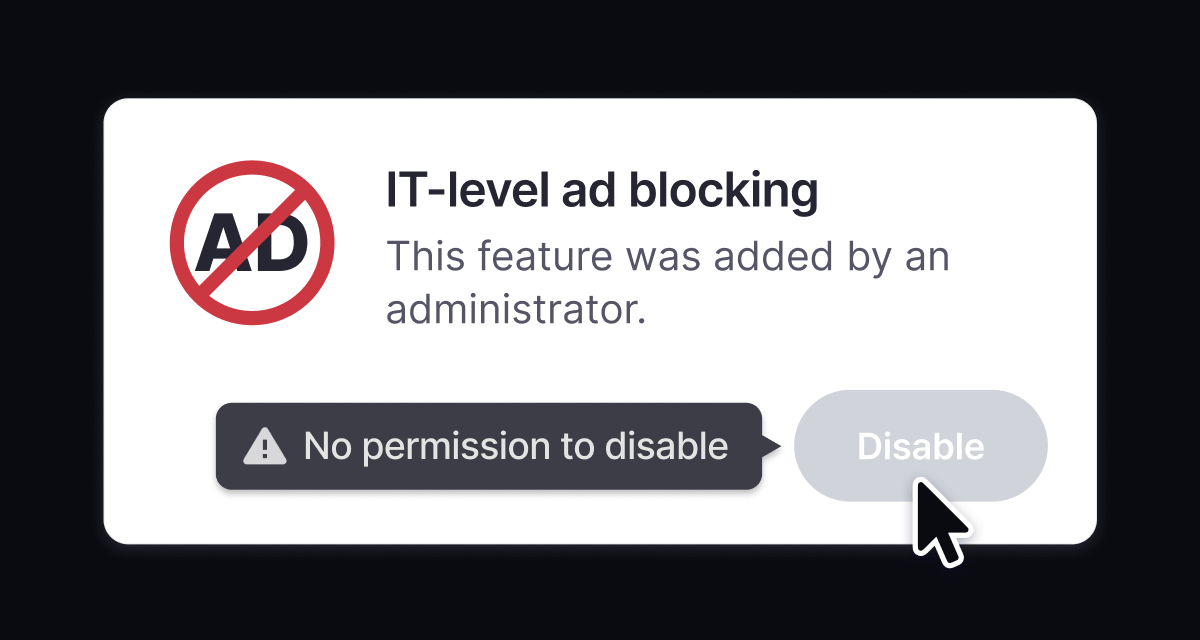
➡️ Now: There’s a new driving force behind adblocking adoption. IT departments are force-installing adblocking across entire organisations — companies, government departments, educational institutions, and public Wi-Fi. The person browsing your site didn’t choose it. They can’t disable it. They often don’t even know it’s active.
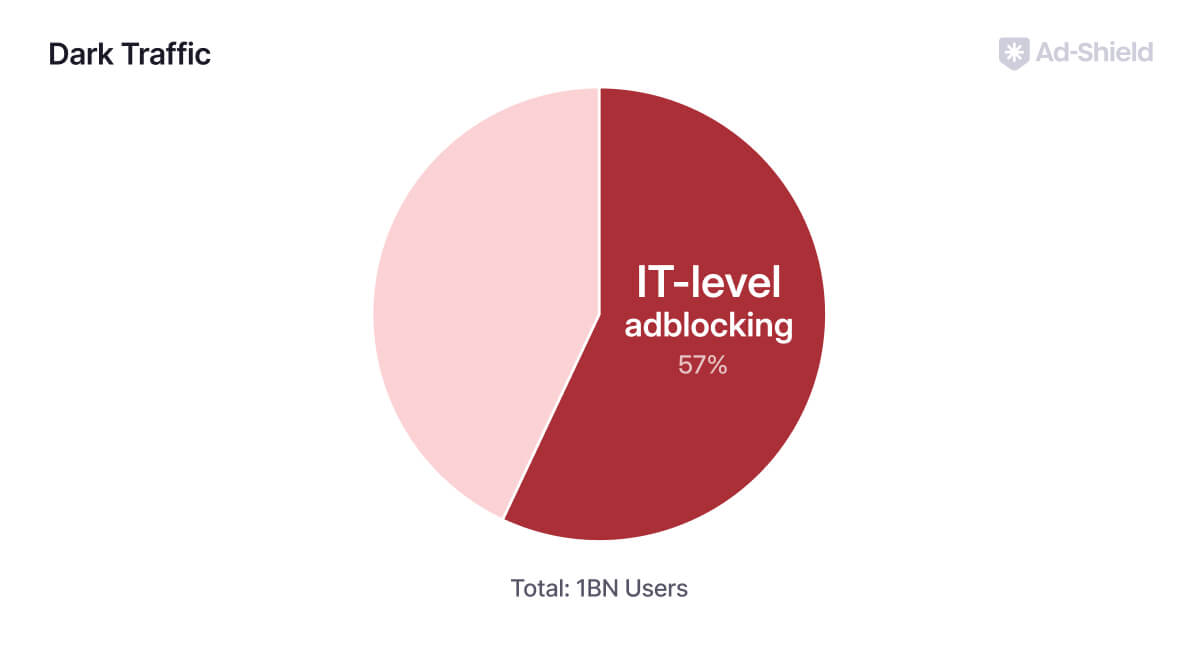
This isn't happening at the margins. Based on our analysis of 5 billion+ page views, up to 57% of users are blocking ads due to IT-level adblocking. That equates to 11% of total internet users.
The Problem
IT-level adblocking renders legacy adblock recovery solutions — such as Acceptable Ads-based products and “turn off your adblocker” walls — obsolete. They are incompatible.
The result: publishers recover $0 for up to 57% of their adblocking audience, unless they have a purpose-built solution to address it.
Here’s why:
Acceptable Ads
Acceptable Ads is a program that allows certain ads to bypass adblockers if they meet specific criteria. Blockthrough relies on this mechanism to recover ads.
But here's the catch — Acceptable Ads is optional. The vast majority of IT managers deploy adblocking without Acceptable Ads enabled, which means no ads serve at all and publishers earn $0 from IT-level adblocking.
Adblock walls
There are two main reasons why “turn off your adblocker” walls are incompatible with IT-level adblocking:
- 🚫 Users can’t turn off their adblocker. Users affected by IT-level adblocking can’t disable their adblocker. The purpose of an adblock wall is to prompt users to turn off adblocking and restore ads — but in this environment, that’s impossible. These visitors lack the control or permissions to change IT-managed settings.
- 🤬 The “turn off your adblocker” message gets blocked. IT managers often deploy adblocking at maximum effectiveness-level settings. This means adblock walls get blocked, as well as ads. Users never see them. The wall doesn't render. Your carefully crafted message? It's invisible. Visits go unrecorded. You don't even know these users exist.
End result? These users are completely unmeasured and unmonetized.
The Opportunity
Here's the part that changes everything: because these users never chose to block ads, they expect to see ads.
They're not anti-ad activists. They're teachers, accountants, office workers. They didn't opt out of viewing ads. IT made the decision. When ads don't load, they just assume your website doesn't have any.
This provides a legitimate basis to restore a normal, user-friendly ad experience (which is exactly what Ad-Shield does). No user preference is being violated. No explicit user choice is being over-ridden. In fact, it’s more like the opposite: delivering what they have come to expect from consuming content online.
What exactly is IT-level adblocking?
IT-level adblocking happens when IT departments deploy adblocking for end users across their entire organization or network. This is not driven by end-users, but instead IT policy.
It occurs through two primary mechanisms:
Network-Level
IT departments deploy adblocking at the infrastructure layer — via firewalls, DNS filtering, and enterprise VPNs. This applies across both private networks (office Wi-Fi, corporate intranets) and public networks (coffee shops, airports, hotels) where filtering is enforced for all end users.
The key difference is where it takes effect. DNS-based filtering typically applies only when devices are connected to the corporate network (most often in the office). VPN-based blocking, however, can remain active regardless of location, both inside and outside the workplace.
Browser-Level Blocking
Enterprise browsers used widely across organizations — such as Chrome, Edge, and Island — allow IT managers to remotely deploy adblockers across thousands of devices with a few clicks. They force-install extensions and browser software, and lock settings so end users can't modify them.
Browser-level blocking follows users everywhere — home, office, industry events, coffee shops. It doesn't depend on a network connection.
The Bottom Line
IT-level adblocking has fundamentally changed the economics of adblock recovery. Traditional solutions like Acceptable Ads and adblock walls were designed for a world in which the overwhelming majority of adblocker users installed them by choice.
That world is now the minority. Today, up to 57% of adblocked traffic is driven by IT-level adblocking — where the end user did not make that decision.
IT-level adblocking is a subset of dark traffic — a broader category of adblocked traffic that legacy recovery tools like Acceptable Ads and adblock walls cannot measure or monetize. Dark traffic accounts for 79% of all adblocked traffic, equivalent to 18% of total internet users.
Ready to restore ads to this audience? 👇

Ad-Shield enables open web publishers to measure and monetize the 79% of adblocking traffic that is not captured by their existing adblock recovery stack.
Most publishers see a 4-5X adblock revenue increase.


.png)

