
Trends & Insights
·
March 3, 2026
Why Don’t Conventional Adblock Recovery Solutions Work With Dark Traffic?
Why Don’t Conventional Adblock Recovery Solutions Work With Dark Traffic?
Trends & Insights
·
March 3, 2026
.png)

compliant

You've probably heard of “turn off your adblocker” walls and Acceptable Ads. Maybe you’re using Blockthrough now.
These are the industry's go-to adblock recovery tools. And for a while, they worked-(ish). Not perfectly, but well enough to warrant using them. They gave publishers a way to engage with users who had chosen to block ads. A way to claw back some of the revenue lost to adblockers.
Here's the problem: that era is over.
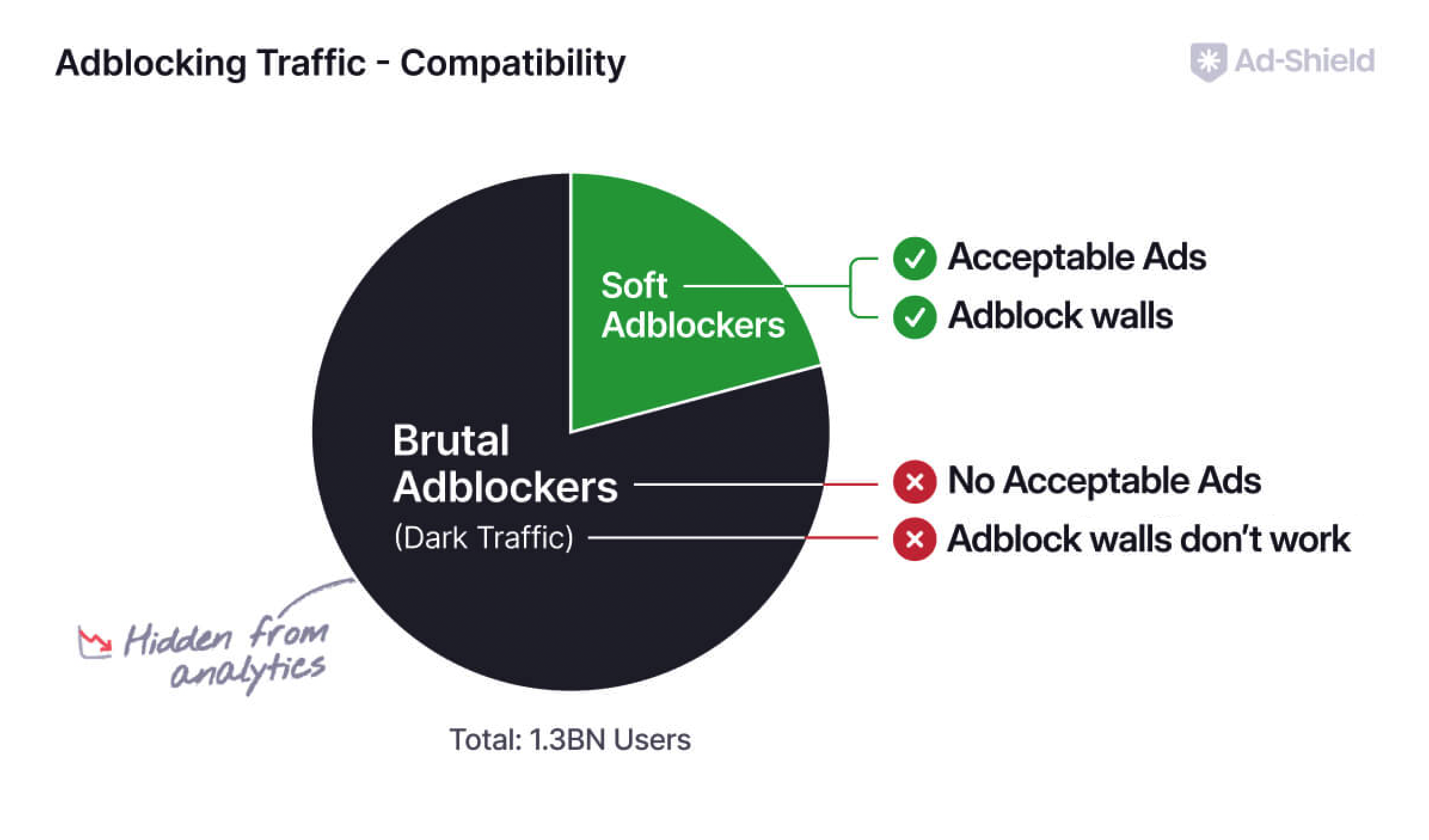
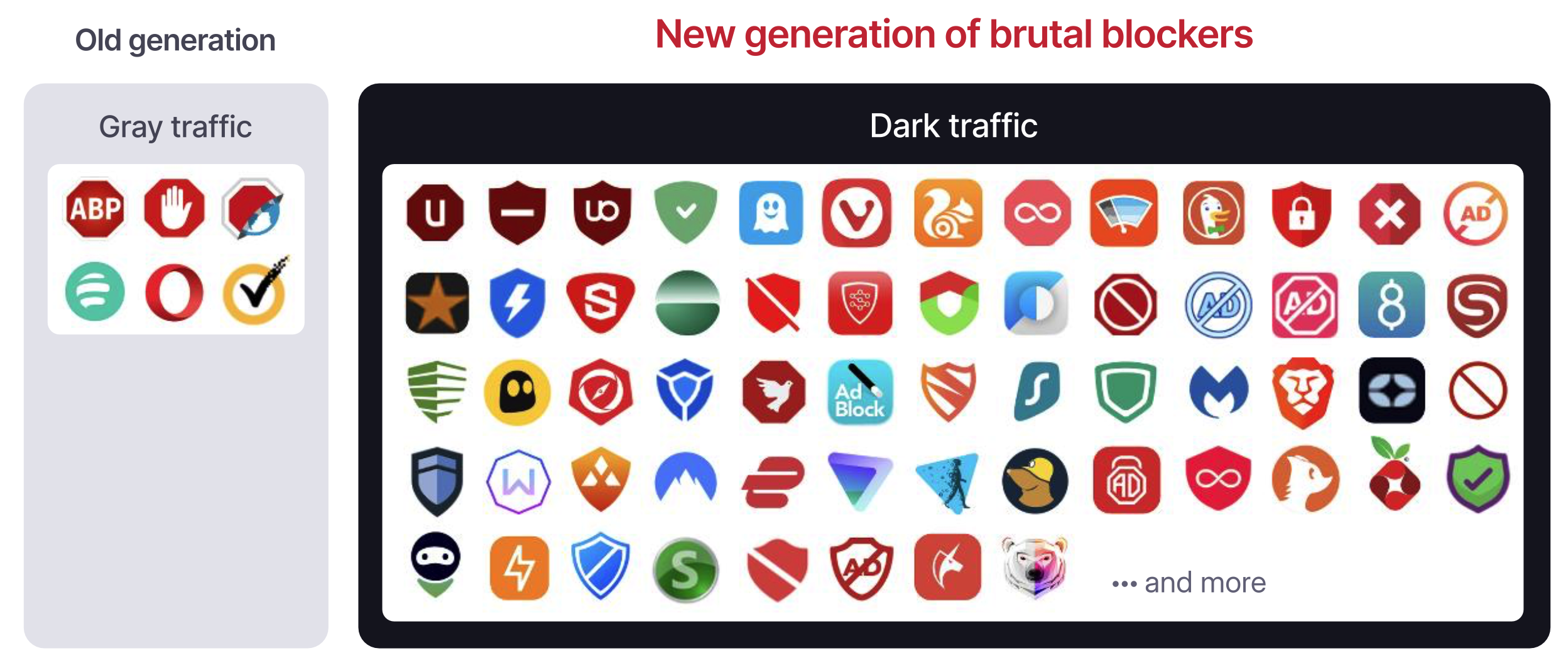
Today, 79% of all adblocking traffic is dark traffic. This is caused by a new generation of brutal adblockers that these tools were never designed to handle. Acceptable Ads, adblock walls, Blockthrough — they’re not setup for it.
💡 Dark traffic: unmeasured and monetized adblocking traffic.
If you're relying on conventional adblock recovery, you're addressing 21% of the problem. The other 79%? You're recovering $0, when you could be recovering 4-5X more than your present number.
Let's break down why.
What Are "Conventional" Adblock Recovery Solutions?
Before we get into the why, let's establish what we mean by conventional solutions. There are two main approaches that publishers have relied upon for the past decade:
Acceptable Ads is a program — originally set up by eyeo, the company behind AdBlock and Adblock Plus — that allows certain ad formats to bypass adblockers if they meet specific criteria. For larger publishers and adtech companies, paying an ongoing whitelisting fee equal to around 30% of revenue generated is required to do this. Blockthrough is the most well-known product built on top of this mechanism. The idea is straightforward: instead of fighting adblockers, work with them. Serve lighter, less intrusive ads that the adblocker has agreed to let through.
Adblock walls take a different approach. When a visitor is detected using an adblocker, a message appears — typically asking them to whitelist the site or disable their adblocker. Google's Funding Choices is one of the more recognizable implementations. The logic is simple: appeal to the good nature of the user. If they agree to disable blocking ads, the publisher gets full ad stack recovery in a few clicks.
Both approaches share the same foundational assumptions:
- The user chose to block ads
- The user’s adblocker is compatible
That assumption made sense when Eyeo’s soft adblockers — AdBlock and Adblock Plus — dominated the market. These blockers are user-installed, support Acceptable Ads, and don’t block adblock walls.
But, they no longer dominate the market. Their market share has collapsed to less than 21%.
Times have moved on. This has expensive consequences.
Why Acceptable Ads-based Solutions Are Incompatible With Dark Traffic
Acceptable Ads operates on a double opt-in basis.
First, adblockers have to agree to participate in the program. Secondly, users of those opted-in adblockers have to opt into seeing Acceptable Ads.
Brutal adblockers, which make up 79% of adblocking traffic, do not opt-in Acceptable Ads. This feature is not supported. Therefore, users can't opt in either.
The result? 100% of dark traffic doesn’t see Acceptable Ads. Not because the ads failed some quality test or the publisher forgot to pay the whitelisting fee, but because the adblockers don’t allow it.
This isn't a configuration issue. It's a structural incompatibility. Acceptable Ads was designed for a world where two adblockers — AdBlock and Adblock Plus — controlled 80%+ of the market. That world ended years ago.
Today, those two products account for roughly 21% of adblocked page views. The remaining 79% comes from hundreds of brutal adblockers — AdGuard, uBlock Origin, Brave, Surfshark, NordVPN, Pi-hole, and many others — that have no relationship with the Acceptable Ads program.
Bottom line: Acceptable Ads generates $0 with dark traffic 👇
Why Adblock Walls Are Incompatible With Dark Traffic
Adblock walls have two jobs: detect that a user is using an adblocker, and then present them with a message. Simple enough.
Against dark traffic, both jobs fail:
🚫 The wall itself gets blocked.
51% of dark traffic page views block adblock walls entirely.
.jpg)
Brutal adblockers don't just block ads. They block the scripts that detect adblocking, and the scripts that render adblock walls, cookie banners, Google Analytics, and everything else publishers depend on to generate revenue. The wall never renders. The user never sees the message. As far as your analytics are concerned, that visit never happened.
❌ Most users can’t disable their adblocker.
57% of dark traffic didn't choose to block ads — an IT manager force-installed it.

Adblockers are no longer primarily installed by the end user. They are activated by a third-party — an IT department, a corporate VPN, a network-level filter, an enterprise browser policy. These users don't have the permissions to disable their adblocker. They can't whitelist your site. They can't turn anything off. Asking them to do so is like asking them to reconfigure their company's firewall.
End result:
80-90% of dark traffic doesn’t disable their adblocker. Either an adblock wall doesn't appear, or it appears to someone who can't do anything about it.
Either way, the outcome is the same: $0 recovered.
What This Means for Publishers
If your adblock recovery strategy begins and ends with Acceptable Ads and adblock walls, here's the uncomfortable math:
Those tools are only effective with 21% of your adblocking traffic. That's the fraction of your adblocking audience that permits analytics, participates in Acceptable Ads, and allows adblock walls to function as intended. The other 79% — dark traffic — is completely outside their reach.
For that audience, you recover $0 for 80-90% of users.
Is there something you can do about it? Yes! Ad-Shield was founded to measure and monetize dark traffic. We are the only adblock recovery solution that specializes in it.
This is not about replacing your existing tools. It's about recognizing their limits and filling the gap they were never designed to cover.

Ad-Shield enables open web publishers to measure and monetize the 79% of adblocking traffic that is not captured by their existing adblock recovery stack.
Most publishers see a 4-5X adblock revenue increase.

.png)

