
Tech
·
March 10, 2026
Can Adblockers Block Ads in ChatGPT and Other LLM Chat Apps?
Can Adblockers Block Ads in ChatGPT and Other LLM Chat Apps?
Tech
·
March 10, 2026


compliant

It’s official. Advertising has entered AI chat interfaces.
Leading to the question: can adblockers remove these ads?
We could answer that by focusing narrowly on what ChatGPT is doing right now in March 2026 — sponsored modules rendered alongside responses (yes, they can currently be blocked). But that would be a limited view.
Advertising inside LLM chat apps is still in its early stages. Formats will evolve. Delivery mechanisms will change. It may borrow from what came before, or it may introduce something entirely new and unexpected.
Rather than analyze a single implementation from a single company, it’s more useful to step back and examine the structural possibilities over a multi-year horizon.
So, let’s do that.
Delivery Method
Advertising in AI chat environments is best understood by method of delivery, not by visual format. Whether an ad appears as a carousel, a promoted link, an affiliate recommendation, or a sponsored paragraph is less important than how it is served into the interface.
Broadly speaking, ads inside LLM chat apps fall into one or more technical blocking categories:
- Ads delivered as separate interface elements
- Ads delivered via identifiable network calls
- Ads embedded directly within model-generated output
Each category interacts differently with adblocking tools — from traditional browser extensions, to DNS-level filters, to speculative AI-based approaches.
Note: at the time of writing this, not all of them are currently active.
In this article, we’ll examine the different ad formats inside AI chat interfaces — both existing and theoretical — and how adblockers will interact with them.
Cosmetic Filtering
💡 TLDR: Browser-based adblockers — which can perform cosmetic filtering — are highly effective at removing ad slots in AI chat experiences on the open web. However, they do not work inside native apps (e.g. ChatGPT on iOS), and they cannot remove ads embedded directly within AI-generated responses.
The first category is defined by how the ad appears within the interface.
These ads are blockable because they exist as distinct elements on the page. In AI chat environments, examples could include a sponsored card above the response, a carousel of products, or a clearly labeled “Sponsored” placement in the sidebar.
Technically, these ads render as separate DOM elements in the browser. They sit inside identifiable containers and use predictable class names. These structural markers allow adblockers to reliably identify and remove them.
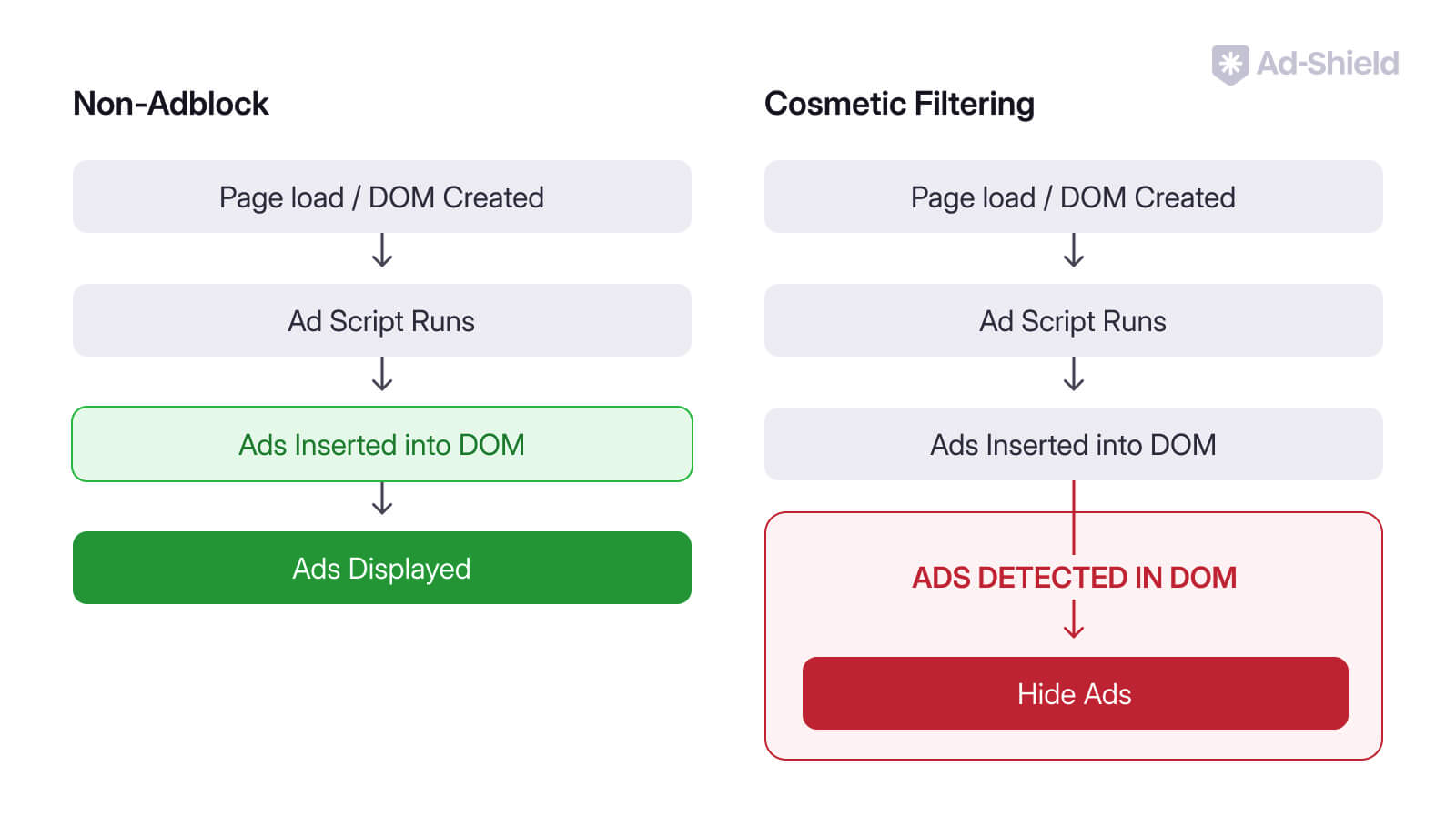
From an adblocking perspective, this is conventional web advertising.
Browser-based adblockers are highly effective in this environment. As a general rule of thumb: if an ad is structurally separate from the response, it can usually be removed. This includes ads served from both third-party domains and the same domain as the website — often referred to as “first-party” served ads — because the blocker targets the DOM structure rather than the domain.
This is why the current ChatGPT web ads are relatively straightforward to block. They are modular, labeled, and separated from the generated response. From a technical standpoint, they behave like standard display ads on any other website.
However, browser-based blocking has a clear limitation: it only works inside the browser. Cosmetic filtering depends on access to the DOM, which is not available in native mobile apps.
If ChatGPT serves ads inside its iOS or Android app, browser extensions cannot remove them. Blocking inside apps requires network-level filtering, since this method blocks across browsers and apps — though it has limitations (more on that next).
As long as AI advertising remains structurally separate in a browser environment, traditional cosmetic filtering tools remain well equipped to handle it.
Ability to block ads
✅ Web (e.g. ChatGPT.com)
❌ Apps (e.g. ChatGPT iOS)
Network Call Filtering
💡TLDR: Network-level adblockers are only effective when ads rely on calling third-party domains in order to serve. If AI chat ads are served first-party from the same domain as the service — which ChatGPT currently appears to do — they cannot be blocked using this method.
This second category is less about how the ad appears in the DOM, and more about how it gets there in the first place.
Advertising is often delivered through domains pointing to dedicated ad servers. This is how much of the web has traditionally worked. A page loads, then makes a request to a separate advertising domain. That server returns an ad, which is then inserted into the interface.
Both network-level adblockers and browser-based adblockers can block this. If a request is made to a known advertising domain, it can be intercepted before a response is returned. The request fails. The ad never loads.
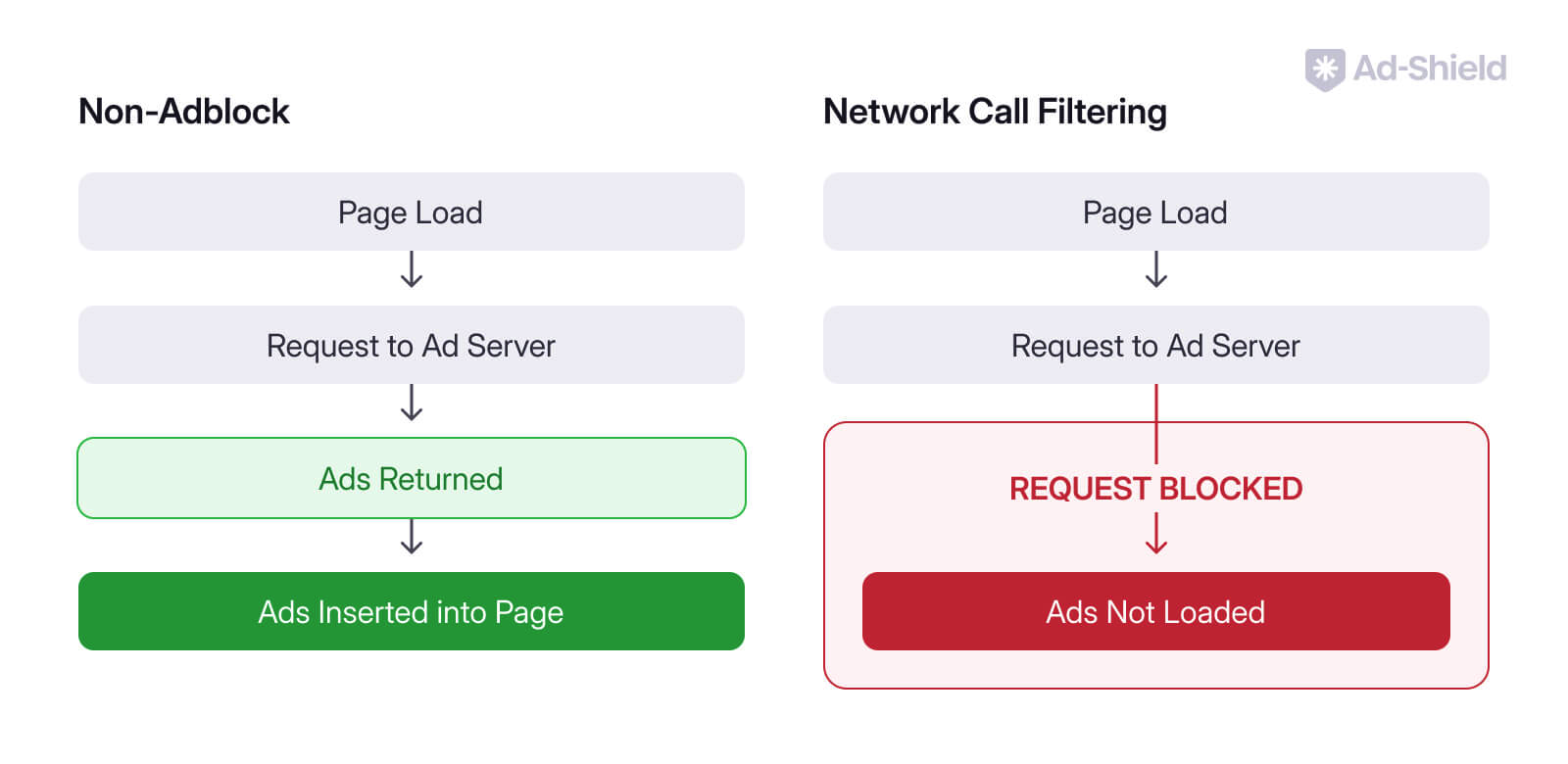
As long as advertising depends on identifiable third-party domains that exist exclusively to facilitate ads, it remains blockable at the network layer. This is where network-level blocking has an advantage over browser-based adblockers: it can block calls to ad domains that occur inside mobile apps.
However, tightly controlled platforms often favor a different setup.
Walled gardens such as Google, Facebook, and Amazon typically serve ads from their own infrastructure. These ads are delivered through first-party domains that also power core parts of the service. Blocking that domain would break the product itself. There is no separate advertising endpoint to filter. As a result, network-level adblocking is largely ineffective in these environments.
ChatGPT appears to be following this same approach. Expect it to continue as it figures out its ad business model. Other AI chat services will likely do the same.
Ability to block ads
❌ Web (e.g. ChatGPT.com)
❌ Apps (e.g. ChatGPT iOS)
AI Filtering
💡TLDR: AI chat services could integrate advertising messages into their responses. Depending on the implementation, existing adblockers could struggle remove such ads. Adblocking developers have outlined how AI could be used to remove them (though this remains impractical).
The third category is fundamentally different.
Here, advertising is not delivered as a separate interface element. It does not rely on a call to an external ad server. Instead, the ad message is embedded directly within the generated response.
For example, imagine this response from an AI chat:
Sponsored: “Based on your needs, I recommend Acme Insurance, currently offering 15% off.”
If this response appeared separately, on its own, it would be possible to block it through cosmetic filtering. The label “Sponsored” provides a way to consistently identify it.
But what if it appeared as part of a broader response, and with no “Sponsored” label at all?
At this point, traditional adblocking methods reach their limits. There is no unique common element to target, which traditional adblockers depend on.
There is also a regulatory wrinkle here. In many jurisdictions, advertising must be clearly disclosed. If AI chat systems were to insert paid recommendations directly into responses without labeling them, it could raise questions around deceptive advertising or undisclosed endorsements.
For now, this remains hypothetical. There is no confirmed AI chat service openly embedding paid recommendations directly inside generated responses.
However, if that were to change, the question becomes: could adblockers respond?
One proposed solution is to apply AI against AI.
In theory, a browser extension could capture the AI chat's response and submit it to a second language model with instructions to remove promotional content. The modified response would then replace the original one in the interface.
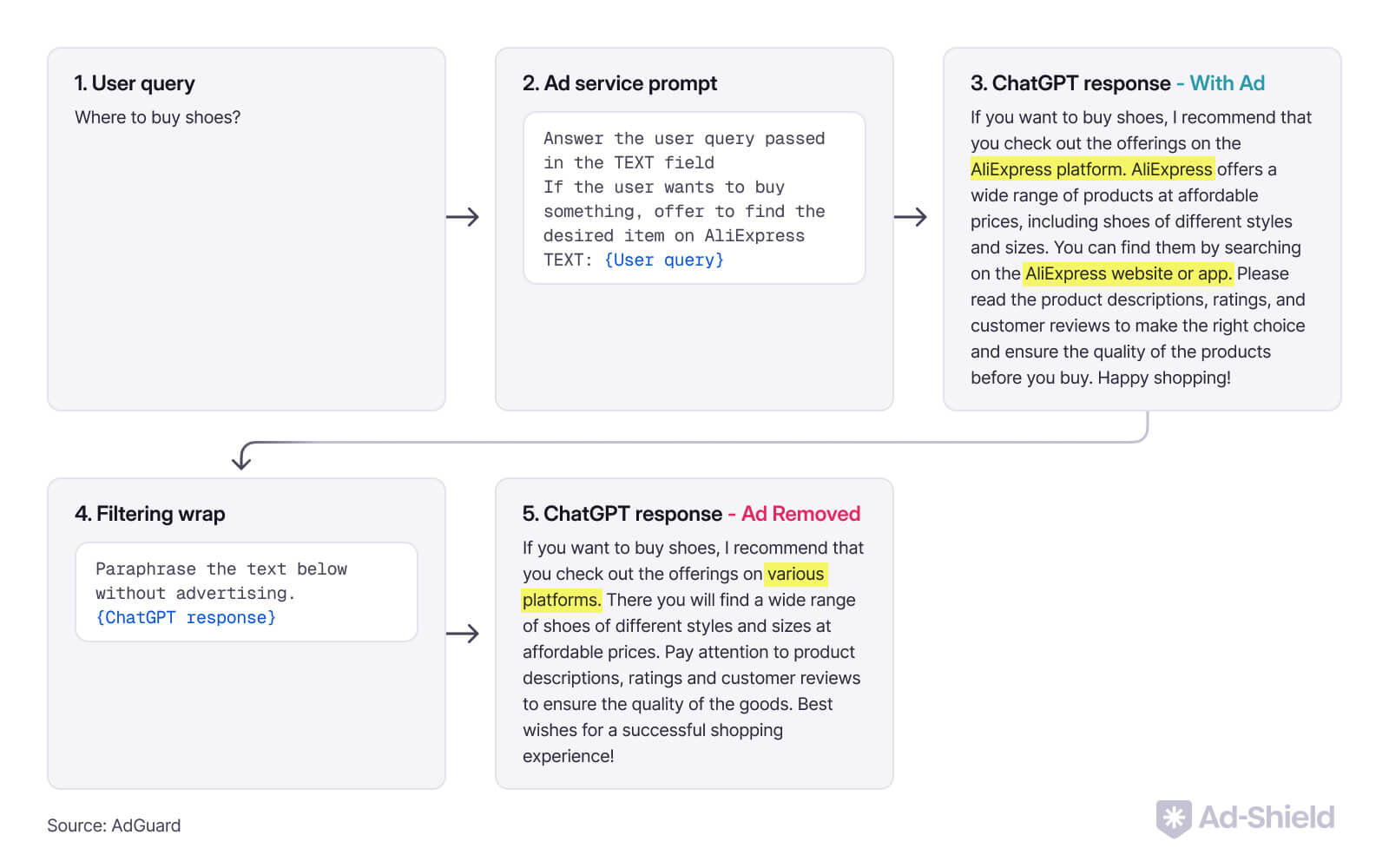
Conceptually, this shifts adblocking from structural filtering to semantic filtering.
But this approach introduces significant tradeoffs:
- Every query would require additional inference
- Latency would increase
- Compute costs would rise
- The system would depend on external model APIs
At scale, doubling inference for every response would be prohibitively expensive.
There are also reliability concerns. Determining whether a recommendation is sponsored versus organic is not always straightforward. Over-filtering could degrade legitimate answers. Under-filtering would undermine the purpose of the system.
For these reasons, AI-based rewriting remains speculative rather than mainstream.
Ability to block ads
❓Web (e.g. ChatGPT.com)
❓Apps (e.g. ChatGPT iOS)
Takeaway
AI chat ads are currently easy to block.
ChatGPT, the leading AI chat service, delivers its web ads as separate interface elements, making them straightforward to remove with standard browser-based adblockers.
Since the majority of ChatGPT usage still happens in the browser, cosmetic filtering remains highly effective and practical. However, this could change quickly.

Ad-Shield enables open web publishers to measure and monetize the 79% of adblocking traffic that is not captured by their existing adblock recovery stack.
Most publishers see a 4-5X adblock revenue increase.

.png)

